Case Study
TM Cafe: Trust Before Discovery on a 12M-User Marketplace
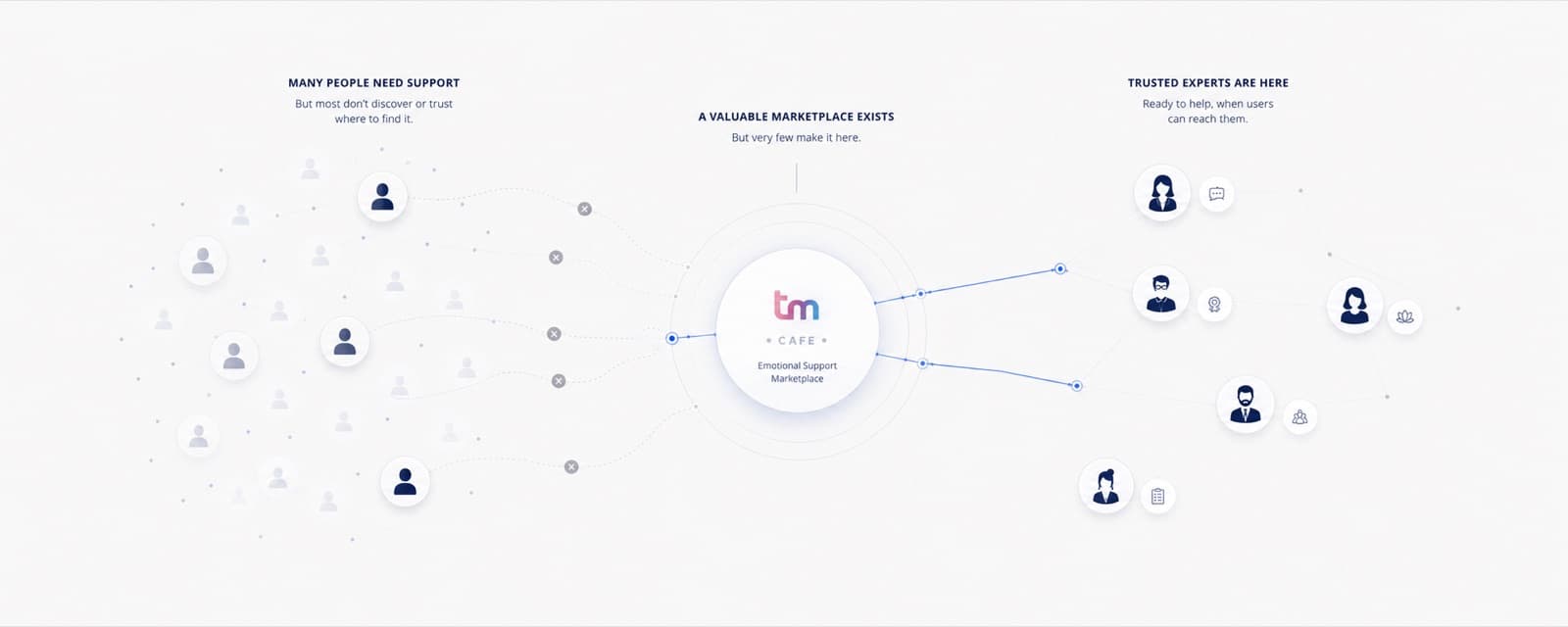
An emotional-support marketplace existed inside TrulyMadly, but almost nobody discovered or trusted it. I identified the failure points and designed the trust and distribution systems needed to make it viable.
Built with:Secondary Research · RICE Prioritization · Behavioral Segmentation · Unit Economics · Prototyping
Outcome
Prioritised two interventions using RICE, built a 7-screen prototype, and modelled revenue across three adoption scenarios.
The Setup
TrulyMadly has two assets most emotional-support startups would spend years building. It has 12 million registered users who hit rejection, ghosting, and loneliness inside the app every week.1 And it has TM Cafe: an embedded marketplace of coaches, listeners, and astrologers, sitting at the exact point where the emotional trigger lands.
What it doesn't have is anything connecting the two.
The market validation isn't speculative. Astrotalk did ₹1,182 Cr in FY25 revenue selling per-minute emotional and relationship guidance over the phone, paid by UPI, with a 25–30% monthly repeat rate.2 Indians pay strangers for emotional advice, and they come back. TM Cafe's FY24 revenue was about ₹9.5 Cr, roughly 1% of what Astrotalk earns from the same behaviour in an adjacent market.3
So the question was never whether TM Cafe could work. It was: why does nobody find it at the moment they need it most?
NOTE
A constraint I want to be upfront about. I had no access to TM Cafe users or experts, so there were no primary interviews. Everything here is built from public data, Reddit evidence, and labelled behavioral hypotheses. I've marked the confidence level on the load-bearing claims rather than smoothing over it.
How I Structured the Research
Because I couldn't run interviews, I separated what I knew from what I was assuming, in three layers.
- Layer 1Verified public data (high confidence)
Astrotalk FY25 revenue (₹1,182 Cr), repeat rate (25-30%), expert count (~41K) from filings and press. TrulyMadly FY24 revenue (₹9.5 Cr) and 45% Tier 2/3 share from CEO interviews. Indian dating-app MAU declines (20-55%) from Economic Times analysis.
- Layer 2Qualitative Reddit evidence (medium confidence)
40+ posts across r/IndianDating, r/TwoXIndia, r/ThirtiesIndia, r/IndianBoysOnTinder. Self-selected voices, not a representative sample, but the emotional patterns were consistent: ghosting, rejection burnout, decision fatigue, persistent loneliness.
- Layer 3Behavioral hypotheses (low confidence, testable)
Trigger-detection feasibility, free-to-paid conversion, nudge CTR, session frequency. Informed by Astrotalk's public metrics and marketplace benchmarks. Each one is flagged as an assumption and carries a validation method.
The discovery-failure number that anchors this whole case carries the same caveat. I estimate it at over 99%, but that's a directional figure: I derived it from the near-total absence of TM Cafe mentions across app-store reviews and the relevant subreddits, not from platform analytics I never had.4
The Problem
TM Cafe is the only emotional-support marketplace embedded inside a dating app, positioned at the exact moment rejection, loneliness, and relationship confusion hit. And it's invisible. Zero app-store reviews mention it. Zero Reddit threads reference it. Users who need it most go and vent to strangers on Reddit, because they don't know the thing exists inside the app they already have open.
Three barriers explain it.
INSIGHT
Discovery. No behavioral trigger links a dating failure to a Cafe entry point. It's a tab you have to already know to go looking for. My funnel estimate has 70-80% of triggered users leaving the app without ever encountering Cafe.
The second barrier is trust. When a user does land on Cafe, there are no visible ratings, no session counts, no social proof. Faced with "Astrologer Agasthya, 4.8 stars, 12,000 sessions" on Astrotalk versus "Coach Eva, 4.5 stars, ??? sessions" on Cafe, the user picks Astrotalk every time. Not because astrology is better advice, but because the trust signal is legible. My estimate is a 50-60% drop-off from the expert list before a session starts.
The third is timing. Emotional pain after a trigger peaks for two to three hours, then fades. Astrotalk's flow is open, pick, talk. TM Cafe makes a user in that window navigate to a separate section. By the time they've found it, the intent has cooled.
Hypothesis
Behavioral signals already inside TM (rapid swipe exits, message drop-offs, profile-comparison loops) can detect emotional distress in real time with enough precision to nudge without feeling invasive.
What we found
Untested. It's plausible: Astrotalk's timing-based model works on far less context, and TM holds behavioral data no standalone app can see. But it depends entirely on whether TM's event logging captures these signals at the needed granularity, which is an engineering question I couldn't verify.
Implication
Validate trigger detection with a narrow, high-confidence signal set and a conservative precision threshold before scaling any nudge. A creepy nudge destroys trust permanently, so precision beats recall until the false-positive rate is measured.
The Funnel, Honestly Labeled
I mapped the trigger-to-payment funnel and marked each stage as evidence or assumption, because most of it is the latter.
| Stage | Drop-off | Evidence or assumption |
|---|---|---|
| Trigger fires (ghosted, rejected, lonely) | baseline | Evidence: 20-55% MAU declines, high uninstall, burnout signals |
| Opens TM during distress | ~70-80% | Assumption: no data on who opens TM vs copes elsewhere |
| Discovers Cafe | ~90-95% | Evidence: zero Cafe mentions in reviews or forums |
| Browses experts | ~50-60% | Assumption: marketplace benchmarks |
| Starts free session | ~30-40% | Assumption: Astrotalk model |
| Pays | ~40-60% | Assumption: 5-15% free-to-paid benchmark |
| Returns within 7 days | ~60-70% | Assumption: Astrotalk 25-30% repeat |
Run the math on 500K MAU and roughly 50K weekly triggers and you land at something like 80-250 monthly payers against a notional 75K target. That gap is the reason I set a realistic 12-month goal of 2-5% of MAU paying, not the 15% the brief implied. I'd rather state a target I can defend than one that looks impressive on a slide.
What I'd Build, and in What Order
I generated 12 solutions and scored them on RICE. Two rose to the top, and the order between them is the real decision.
| Solution | Reach | Impact | Effort | Score |
|---|---|---|---|---|
| Expert Trust Layer (ratings, session counts, specialization tags)top | 6 | 9 | 7 | 302 |
| Post-Rejection Smart Prompt (narrow validation of the nudge thesis) | 6 | 7 | 8 | 235 |
| Moment-Match Nudge Engine (full behavioral trigger detection) | 8 | 8 | 5 | 224 |
| Empty-State Cafe Card (surfaces Cafe when chat tab is empty) | 5 | 5 | 9 | 135 |
| Open Expert Marketplace (external onboarding, 70/30 share) | 9 | 9 | 3 | 135 |
RICE: Reach × Impact × Confidence × Effort (effort inverted, 10 = easiest). Scores are my estimates, not measured outcomes.
DECISION
Trust before discovery. The Expert Trust Layer scored highest because trust is the conversion bottleneck. Users who do find Cafe still bounce without it. So I'd build visible ratings, specialization tags, and social proof first, then turn on the nudge engine to route traffic into a marketplace people believe in. Invert that order and every rupee of nudge spend lands on a leaky funnel.
There's a second non-obvious call buried in the scores. Open Marketplace ranked mid-table on RICE because the effort is brutal, but I flagged it as non-optional infrastructure that has to run in parallel from Month 1. Without supply depth, a working nudge engine just overloads 10-15 experts and degrades quality, which permanently burns the one asset the whole strategy depends on. I took the execution cost upfront rather than hit a supply ceiling at Month 4.
The Prototype
I built the end-to-end flow as a working 7-screen prototype: the moment-match nudge, the context-filtered Cafe landing, an expert profile carrying real trust signals, the in-call free-session timer, the post-call rating and wallet prompt, the UPI recharge, and an AI triage chatbot that routes a user to the right expert.
The user journey it walks through, for the "ghosted swiper" persona:
- T+0Trigger
Third unmatch this week. The chat disappears. Behavioral signals (rapid swipe exits, message drop-offs) suggest distress.
- T+15sContextual nudge
An overlay surfaces: 'Conversations ending too soon? A dating coach can help. First 10 min free.' Hypothesised CTR: 8-12%.
- T+30sExpert discovery
Curated coaches, pre-filtered to the trigger. Ratings, session counts, response time, and review snippets visible before any commitment.
- T+11mFree session
First 10 minutes free. Private, audio. The expert sees the trigger context and reviews the user's profile live. Hypothesised free-to-paid: 12-18%.
- T+12mConvert
Continue at a per-minute rate, anchored against a shown average session cost (~₹120), with a one-tap UPI wallet top-up.
- T+3-7dReturn loop
Outcome-linked nudge: 'Your opener worked, 3 new matches this week.' Habit over one-off transaction.
One trade-off I made deliberately in the prototype: a 10-minute free trial over 5 minutes. Five minutes is cheaper and harder to abuse, but coaching needs enough time for the user to feel heard before being asked to pay, especially the post-breakup persona. I accepted the higher acquisition cost to improve the odds of conversion, with a note to revisit it once there's real data.
Why the Model Works (and Where It Doesn't)
Revenue here is a driver model, not a forecast:
MAU × trigger rate × discovery rate × conversion × repeat rate × ARPU.
Each lever maps to a build. Discovery rate to the nudge engine, conversion to the trust layer, repeat rate to outcome-linked habit features, ARPU to session packs and wallet bonuses.
| Scenario | MAU | Discovery | Conversion | Modeled monthly revenue |
|---|---|---|---|---|
| Conservative | 400K | 5% | 10% | ₹1.8L |
| Moderate | 500K | 8% | 15% | ₹10.8L |
| Optimistic | 600K | 12% | 20% | ₹51.8L |
I want to be precise about what this table is. These are modeled scenarios driven by assumed conversion and discovery rates, not results. The jump from conservative to moderate is entirely a discovery-and-trust problem, which is exactly what the first two RICE priorities address. The jump to optimistic is a habit-and-retention problem for a later phase. Even the optimistic case sits far below the original 75K-payer target, which is itself a finding: the honest 12-month number is 2-5% of MAU paying.
The Moat, and the Caveat
The defensible thing here isn't "inside a dating app." It's the behavioral data TM holds that Astrotalk structurally cannot: chat drop-offs at the message level, swipe decay over time, real-time rejection signals, match-rate visibility, session timing correlated with emotional state. Astrotalk sees session start and end events. That's it.
That asymmetry compounds. More signals make better nudges, which make better matches, which make better outcomes and stronger retention. But it's an early advantage, not a finished moat. Long-term defensibility still depends on repeat behaviour, expert liquidity, and trusted outcomes, none of which exist yet. Calling it a moat today would be overclaiming.
What I'd Validate First
If this were live, I wouldn't build the full engine. I'd run the cheap experiments that kill or confirm the load-bearing assumptions.
The first is a fake-door "Talk to a Coach" CTA on the post-rejection screen, to measure whether latent demand even exists (success bar: >3% CTR). The honest gap in my own work is that I modeled the 90-95% discovery loss instead of measuring it, and a 48-hour fake-door test would have produced a real number and changed my confidence in the nudge thesis. Get the number first, then design for it.
The second is the post-breakup female cohort I deprioritised in Phase 1. I cut it for supply-matching complexity, but it likely has the highest willingness-to-pay and repeat potential of any segment. A small pilot, two or three specialized coaches, would tell me whether the referral loop there is structurally different before I write the segment off. The pilot is cheap. The downside of ignoring a better acquisition channel isn't.